
March 8 marks International Women’s Day, a global celebration of the achievements of women and a reminder of the importance of advancing equity across all sectors. From science and policy, to entrepreneurship and community leadership, women have played a vital role in shaping the world we live in today.
In the green economy, women are helping lead the transition toward a more sustainable future. Across industries and communities, women are advancing environmental, social, and governance (ESG) initiatives, developing innovative climate solutions, and championing sustainable practices that support both people and the planet. Research continues to show that organizations with greater gender diversity are more innovative and better equipped to address complex challenges. Inclusive leadership is therefore an important part of building a resilient green economy.
At econext, we see this impact firsthand. Women play a major role in shaping econext’s work, representing nearly half of our Board and the majority of our leadership team and staff. Their leadership, expertise, and perspectives help guide our programs, partnerships, and initiatives across the province. We are committed to continuing to build the green economy as a diverse, inclusive, and accessible sector that benefits from a wide range of experiences, ideas, and perspectives.
This International Women’s Day, we celebrate the women who are helping lead the transition to a greener economy, both within our organization and across our network.
Below, you can read stories from some of the women helping shape the green economy. Their experiences highlight the many pathways into sustainability careers and the important role women continue to play in driving innovation, collaboration, and climate action.
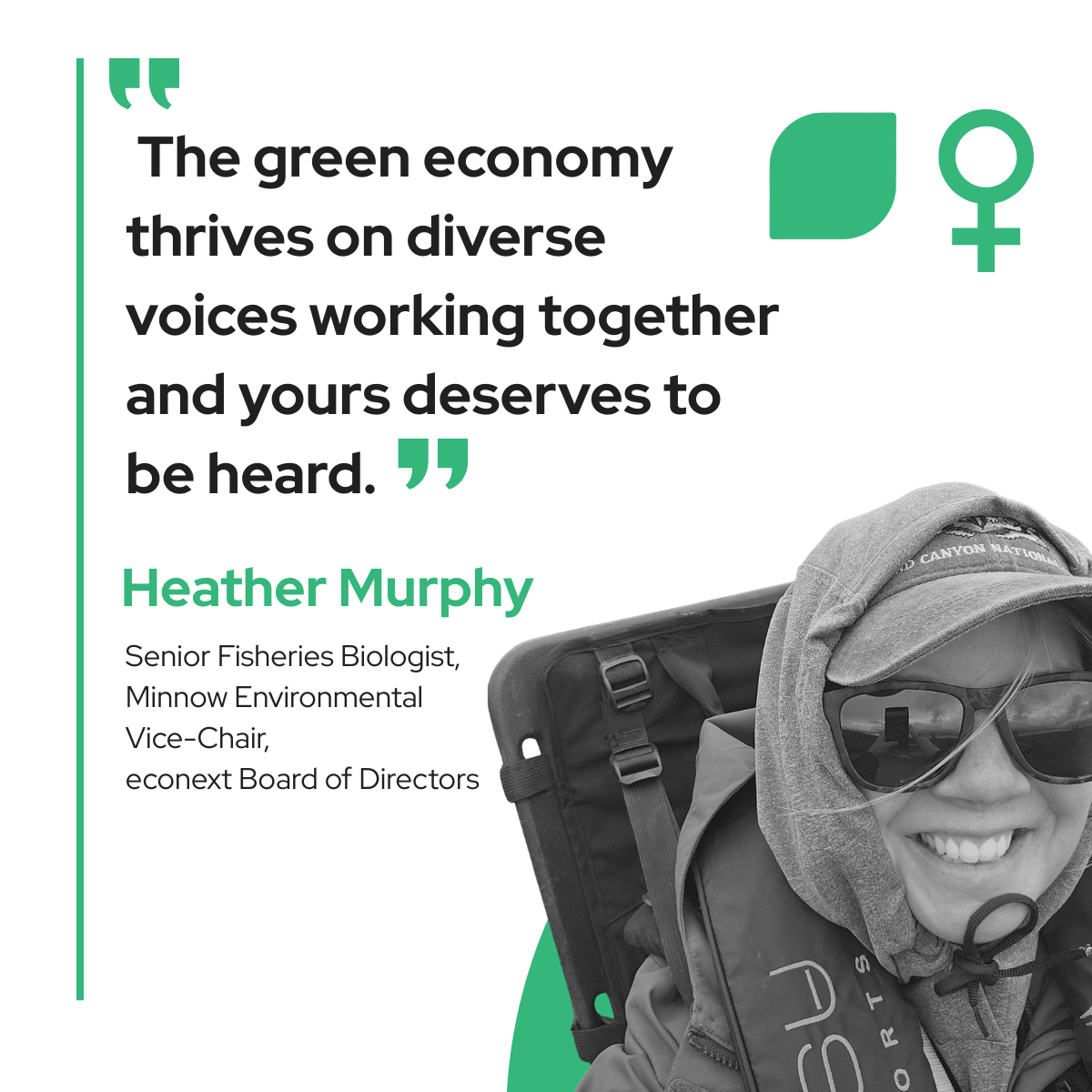 Heather Murphy, Senior Fisheries Biologist, Minnow Environmental & econext Board of Directors Vice-Chair
Can you share how your journey led you to working within the green economy?
My interest in the green economy started long before I entered the workforce. I was fortunate to have professors who encouraged curiosity and exploration early in my academic journey. They saw potential in the questions I asked, and their enthusiasm helped shape my understanding of how science can be used to protect ecosystems and support sustainable economies.
Another part of my journey was learning to say “yes” whenever I was invited to the table. Whether it was a research opportunity, conferences, field project, or a conversation with people working in areas I wanted to understand better. Each “yes” opened doors, strengthened my skills, and connected me with mentors and colleagues who showed me how science and sustainability intersect in practical, meaningful ways.
Those experiences naturally led me toward fisheries biology and environmental stewardship, where every decision has both ecological and economic consequences. Working in the green economy became a way to align my curiosity, my values, and my desire to contribute to solutions that support both the environment and the economy.
Have you faced any barriers in your career? If so, how did you overcome them?
I’ve certainly faced barriers, and one of the most important lessons I learned early on was to be honest about my abilities. Instead of pretending to know everything, I made it a habit to ask questions, seek guidance, and invite feedback from my teammates, mentors and senior leaders whose perspective I respect and appreciate.
Being transparent about what I didn’t yet know didn’t hold me back though. It helped me learn and advance faster in my career. It also built trust within my teams, because people knew I was committed to doing the work well and not just appearing confident. And now, 16 years into my career, I still take this same approach. The learning is never done. Every challenge, conversation, and project adds something new, and staying curious and communicative has been one of the most reliable ways to move past obstacles and continue growing.
Another key lesson was realizing that no one overcomes barriers alone. The best progress happens when you lean on a team. Barriers are overcome when you collaborate, share knowledge, and support each other through the challenges. Recognizing that helped me navigate tough situations with more resilience and far less hesitation.
What message do you think is important for young women entering the green economy?
One of the most important things young women should know is that your voice is a powerful tool! Communication is foundational in the green economy. Whether you’re sharing scientific findings, collaborating across disciplines, or engaging with communities, the ability to communicate clearly and confidently will amplify your impact.
Say yes to opportunities to speak up, ask questions, and contribute to discussions. Even when you feel uncertain, your perspective brings value, and the only way to grow those communication muscles is through practice.
Remember that you don’t have to know everything at the start. What matters is staying curious, being willing to learn, and showing openness in your conversations with mentors, peers, and partners. And just as importantly, understand that progress in this field rarely happens alone. Strong communication within a team, being transparent, listening actively, and sharing knowledge helps turn challenges into collaborative solutions. The green economy thrives on diverse voices working together and yours deserves to be heard.
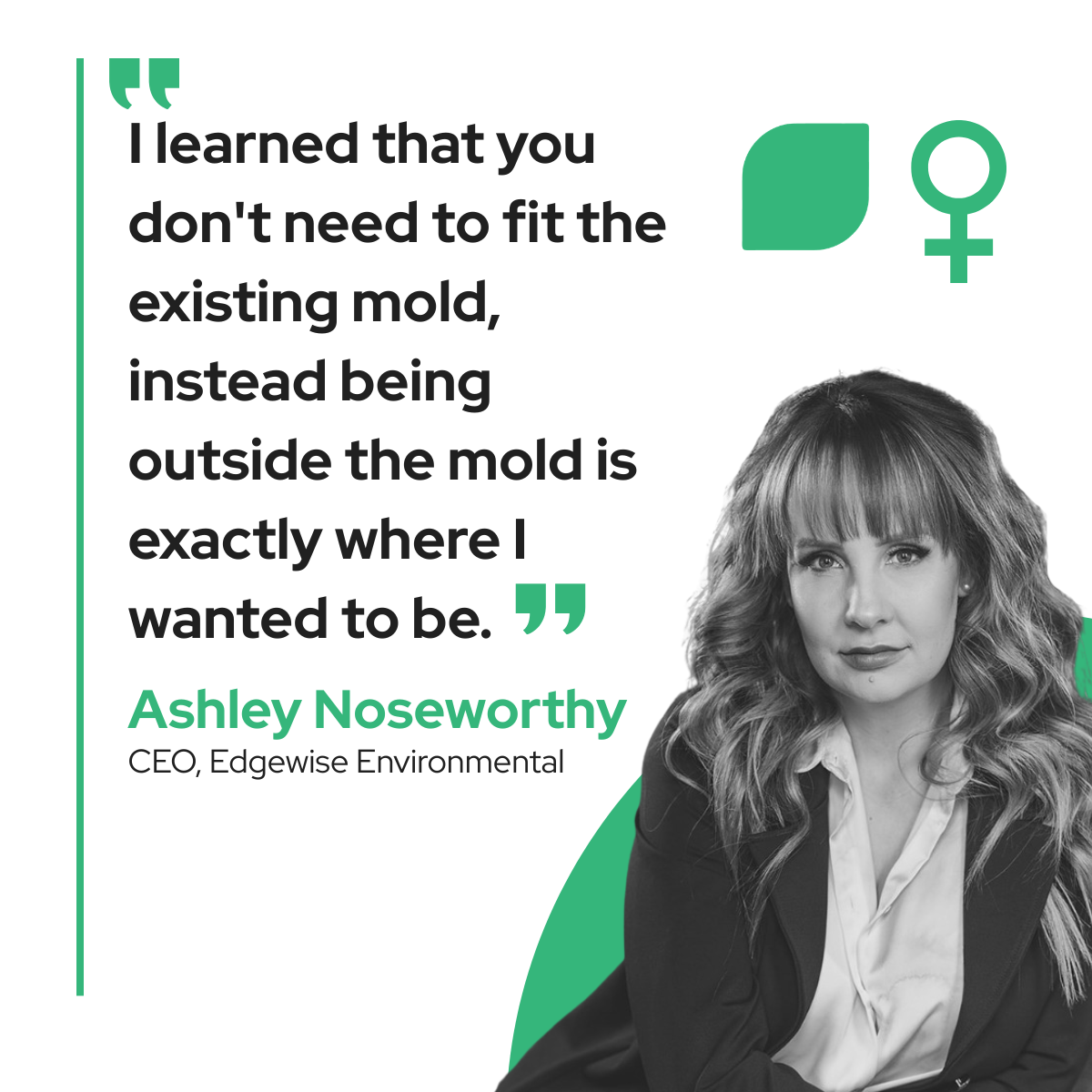 Ashley Noseworthy, CEO Edgewise Environmental
Have you faced any barriers in your career? If so, how did you overcome them?
The marine and industrial sectors and even entrepreneurship have historically been male-dominated, and as a female scientist, founder and CEO, I’ve certainly navigated my share of “only woman in the room” scenarios. Early on, the biggest barrier was often credibility. Whether it was securing investment or leading technical training, there was an unspoken pressure to prove I was twice as capable just to be seen as equal.
I overcame these hurdles by focusing on unapologetic competence and community. I leaned into my expertise, let the results of Edgewise speak for themselves, and sought out mentors, who valued innovation over tradition. I learned that you don’t need to fit the existing mold, instead being outside the mold is exactly where I wanted to be.
What message do you think is important for young women entering the green economy?
To the young women considering a profession in the green economy: don’t wait for an invitation. This sector is being built right now, which means there is a unique opportunity to design the rules of the game. We need your perspective, your problem-solving skills, and your leadership to solve the climate crisis. The “green economy” isn’t just one thing, it’s engineering, policy, biology, marketing, economics, and entrepreneurship (and so much more). Find the intersection of what you love and what the planet needs, and go after it with everything you’ve got.
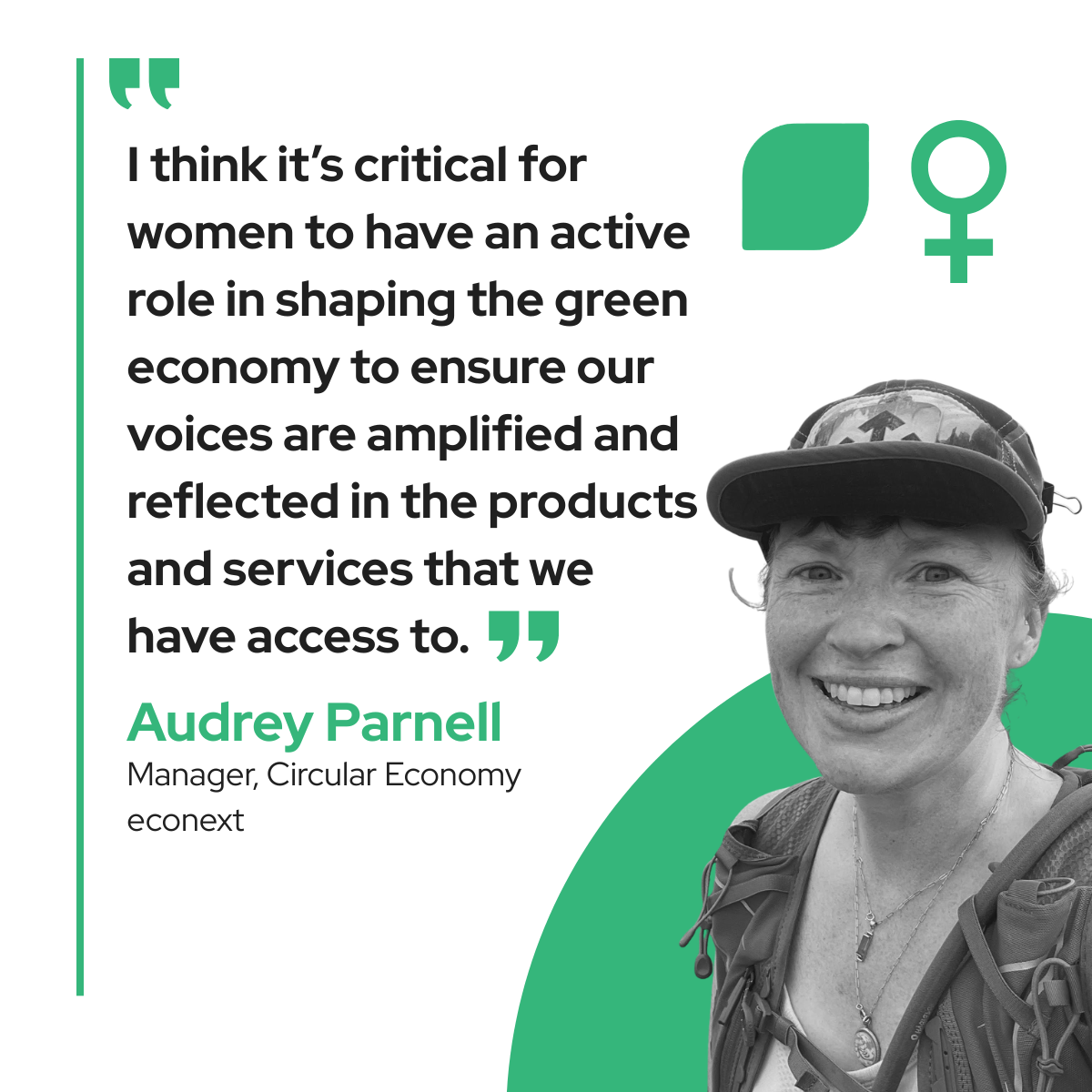 Audrey Parnell, Manager, Circular Economy, econext
Can you share how your journey led you to working within the green economy?
I have always loved the outdoors since I was a child which led me to my BS and MS degrees in Geology – I can get a degree in hiking?! With geology I was able to go from working in Oil&Gas, to climate consulting, and now work at econext in exploring the opportunities to find value in waste. Being a part of the world and thinking about the planet has always been a core part of my life and I am excited to be at this inflection point where we can transform industry towards sustainability.
What message do you think is important for young women entering the green economy?
I think it’s critical for women to have an active role in shaping the green economy to ensure our voices are amplified and reflected in the products and services that we have access to. Women are central to shaping a low emission future through working as engineers to find clean power to as designers developing reusable products.
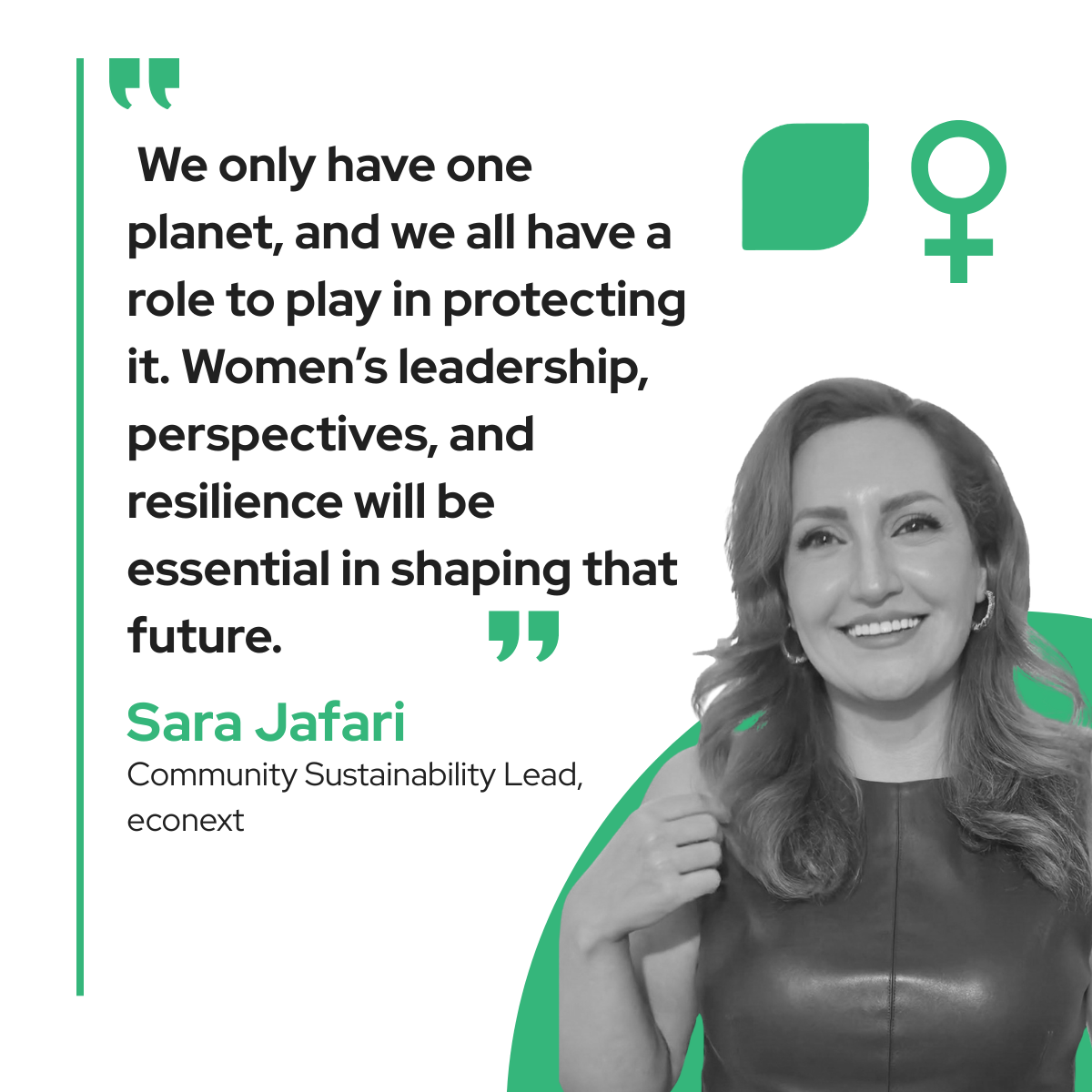 Sara Jafari, Community Sustainability Lead, econext
Can you share how your journey led you to working within the green economy?
My journey into the green economy began with my background in geomorphology and climate studies, followed by a master’s in urban planning, where I focused on the environmental aspects of sustainable urban growth and development. Earlier in my career, I worked in the cleantech and renewable energy sector, which strengthened my interest in sustainable solutions and project management. After moving to Canada and studying MBA at MUN, I had to rebuild my career from scratch. Working with econext allowed me to reconnect my planning and environmental background with climate action, particularly through initiatives like the Net-Zero Communities Accelerator, where I collaborate with NL municipalities and industry partners to support more sustainable and resilient communities.
Have you faced any barriers in your career? If so, how did you overcome them?
As an immigrant woman building a career in Newfoundland and Labrador, one of the biggest challenges was rebuilding my professional network and establishing credibility in a new environment where my previous experience was not always immediately recognized. In smaller communities, professional networks can be tight-knit, which can make career development more challenging for newcomers. I overcame these barriers by continuing to strengthen my expertise, building meaningful professional connections, actively contributing to my projects, and staying focused on the impact I wanted to create. At the same time, I was fortunate to receive support and encouragement from generous colleagues and community members along the way. That support made a real difference, and today I try to pay it forward by supporting and mentoring others whenever I can.
What message do you think is important for young women entering the green economy?
The transition to a sustainable and low-carbon economy requires purpose-driven and solution-oriented people. My message to women entering the green economy is to approach this work with a problem-solving mindset and a strong sense of purpose. Climate action is complex, long-term, and often challenging because the required changes are systemic. But the goal is clear: protecting our environment while building stronger, more sustainable economies and communities. This work can feel like an endless journey, but we do it because we have a responsibility to future generations. We only have one planet, and we all have a role to play in protecting it. Women’s leadership, perspectives, and resilience will be essential in shaping that future.
 Ashley Smith, Owner, Fundamental Inc.
Can you share how your journey led you to working within the green economy?
I’ve always been interested in ‘environmental’ things, it’s been clear to me since my late teens that we need to do a better job of interacting with nutrient and energy cycles of the planet. I got a Bachelor’s degree in population genetics with a minor in chemistry, that led me to work in the area of ‘environmental science’ generally, which led me to become the sustainability coordinator for an urban planning and architecture firm, which led me to LEED and energy efficiency, then I got a Master’s degree in civil and municipal engineering, which led me to construction. I started my own firm when I was pregnant with my first child. I wanted to be the change I wanted to see with respect to action on climate change. And now I’ve been succesffully running Fundamental Inc for 10 years, with each year growing to new clients and new exciting projects. I’m very proud of our B Corporation Status, of the $33Mil in funding we’ve brought to the province for our clients, and that we’ve decoupled our GHG emissions from Fundamental’s economic growth – our 2024 emissions were 32% lower than our 2019 emissions despite our annual revenue being 2.5 times higher. (2025 stats will be ready soon!)
Have you faced any barriers in your career? If so, how did you overcome them?
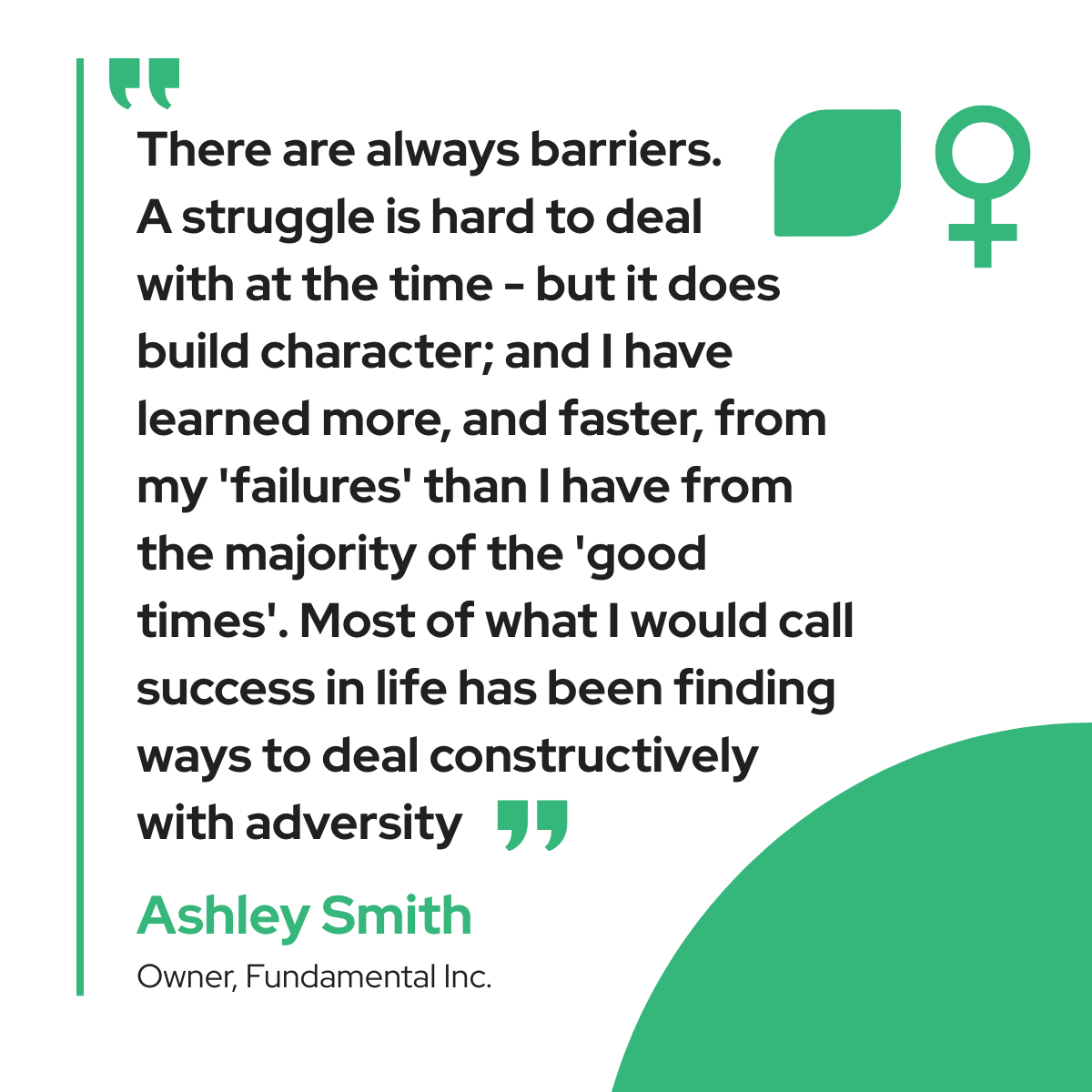
There are always barriers. A struggle is hard to deal with at the time – but it does build character; and I have learned more, and faster, from my ‘failures’ than I have from the majority of the ‘good times’. Most of what I would call success in life has been finding ways to deal constructively with adversity. I am not a confrontational person – in fact, I will go seventeen ways from Sunday to avoid open conflict whenever possible – but, when push comes to shove, I will stand firm and hold my ground with respect and kindess (or solid preparation, evidence, and determination – as the situation warrants). I’m a firm believer that what you get out of life is directly proportional to what you put into it. In my experience owning and running a business – you have to see the hard work as a given, be primarily motivated by something deeper than accolades and money, and hope that you get a few lucky breaks. I am a profoundly pragmatic person – when you know something isn’t right, it isn’t – acknowedge it (freak out in a safe place if you need to), get over it (breathe – this too shall pass), and move towards what works (stopping every now and again to hug your family and smell the roses).
What message do you think is important for young women entering the green economy?
I would say this is true for all disciplines and industries, and all humans in general really – care enough about the thing you’re doing to do the work needed to get good at it. Short cuts are trouble. Take responsiblity for your actions and what you bring to the table. Lean into helping others around you – especially in NL where the market is small enough that relationships really matter. Abandon ‘protectionist’ notions and remember that a rising tide really does lift all ships. I tell my kids all the time – teamwork really does make the dream work.



Our newsletter is the #1 source of information on news, events, and projects relevant to Newfoundland and Labrador's clean growth priorities.