
econext reacts to release of Newfoundland and Labrador 2025-30 climate action plans

For Immediate Release
June 30, 2025

econext sees many of its environmental/economic priorities reflected in the climate change actions plans released by the Government of Newfoundland and Labrador today.

“We are pleased to see the action plans presented through a lens of opportunity for Newfoundland and Labrador,” said Kieran Hanley, econext‘s CEO. “Some of the biggest economic opportunities that we have in this province – whether it’s new clean electricity generation, hydrogen production, or critical minerals – when realized will also help the province to address sectors of our economy like transportation and heavy industry that are the most difficult to decarbonize.”

Today the Government of Newfoundland and Labrador published its 2025-30 climate change mitigation and adaptation action plans.

Last July econext submitted a series of recommendations to the provincial government in the development of its new climate change action plans. econext presented 19 recommendations across 7 themes ranging from ensuring long-term access to clean electricity to maximizing domestic clean fuels opportunities.

“The climate action plans published today echo many of the same priorities that we had identified,” said Hanley, “in fact, we have seen progress on some of them even since last year.” Hanley noted that the mitigation plan establishes a 2040 greenhouse gas (GHG) reduction target and reiterates the provincial government’s commitment to net zero GHGs by the year 2050. “These are important indicators that create certainty for all stakeholders in the direction Newfoundland and Labrador is moving in.”
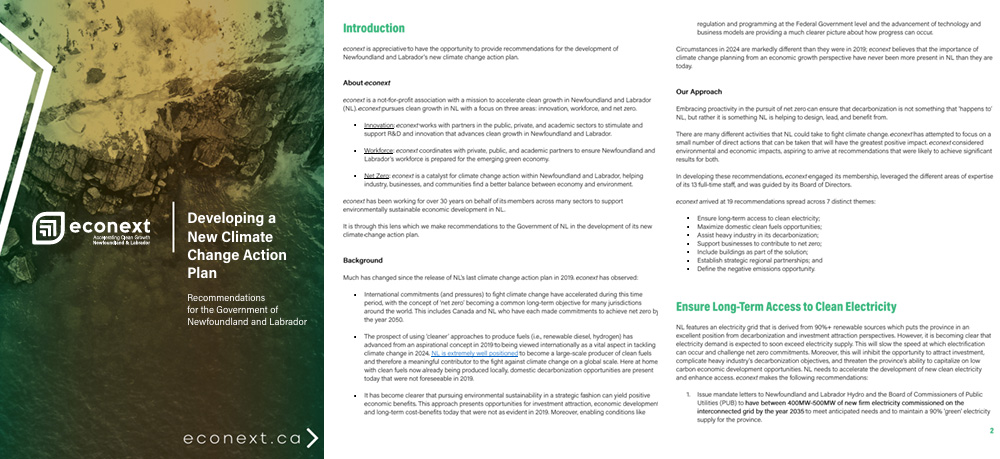
In July 2024 econext submitted a series of 19 recommendations for the provincial government to consider in the development of its 2025-29 climate change action plans.

Hanley says that econext looks forward to continuing to help the province establish links between economic opportunity and environmental sustainability. “We recently published two discussion papers – one on domestic clean fuels use, and other focused on biomass energy – which present important findings as they relate to the province’s green economy and its pursuit of net zero.”

Hanley also noted that econext is currently working with six municipalities across the province to help them develop net zero plans, has had programming since 2021 to help communities and industries across the province adapt to the impacts that climate change is already having, has developed programming to help businesses across their province assess their environmental impacts, and has launched a circular economy incubator.

econext and its members are hard at work to solve the environmental challenges identified in the climate change action plans, and we look forward to partnering with the provincial government where appropriate to advance these initiatives while growing Newfoundland and Labrador’s green economy in the process.”

Net Zero Advisory Council final report released

As part of the announcement today, the provincial government publicly released the final recommendations of the Net Zero Advisory Council (NZAC). econext CEO Kieran Hanley served as the Chair of the NZAC from 2021-24.
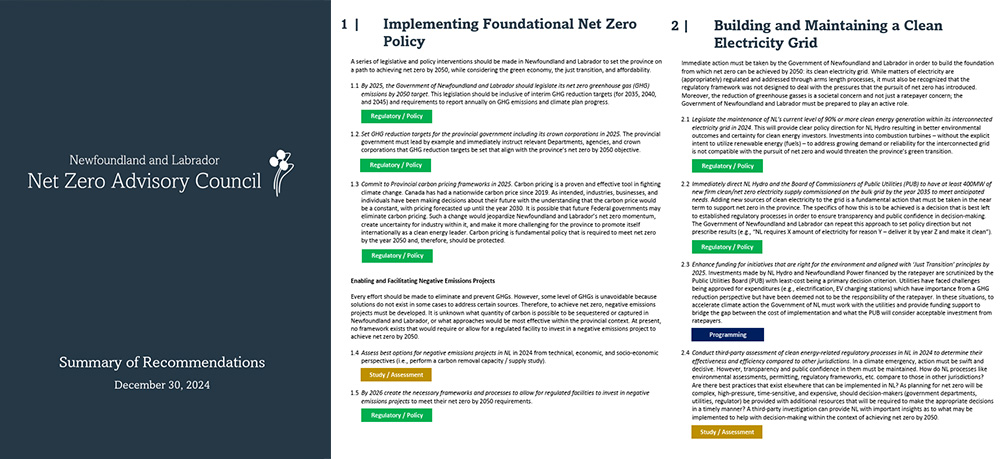
From December 2021 until December 2024, econext CEO Kieran Hanley served as the Chair of Newfoundland and Labrador’s Net Zero Advisory Council (NZAC). Today, this NZAC’s final report was released.

“From a personal perspective, I’m excited to see the the document published and am proud of the recommendations that the Council put forward to the Government of Newfoundland and Labrador,” said Hanley. “I am happy that many of our findings are reflected in the climate change action plan, and am thankful to the members of the council for their commitment – each of whom volunteered a lot of time over three years to the effort.”

About econext

econext is a not-for-profit association with a mission to accelerate clean growth in Newfoundland and Labrador by: (1) stimulating research, development, and innovation; (2) preparing its workforce for a greening economy; and (3) acting as a catalyst for climate change action within its industries, businesses, and communities. econext has been working for over 30 years on behalf of its members across many sectors to support environmentally sustainable economic development. For more information, visit https://econext.ca/.
CEO Message – Newfoundland and Labrador’s emerging clean energy industry becoming recognized far and wide

This Spring I had the fortune and honour of traveling far and wide on behalf of econext, representing the the interests of the association’s members and (hopefully!) those of Newfoundland and Labrador.

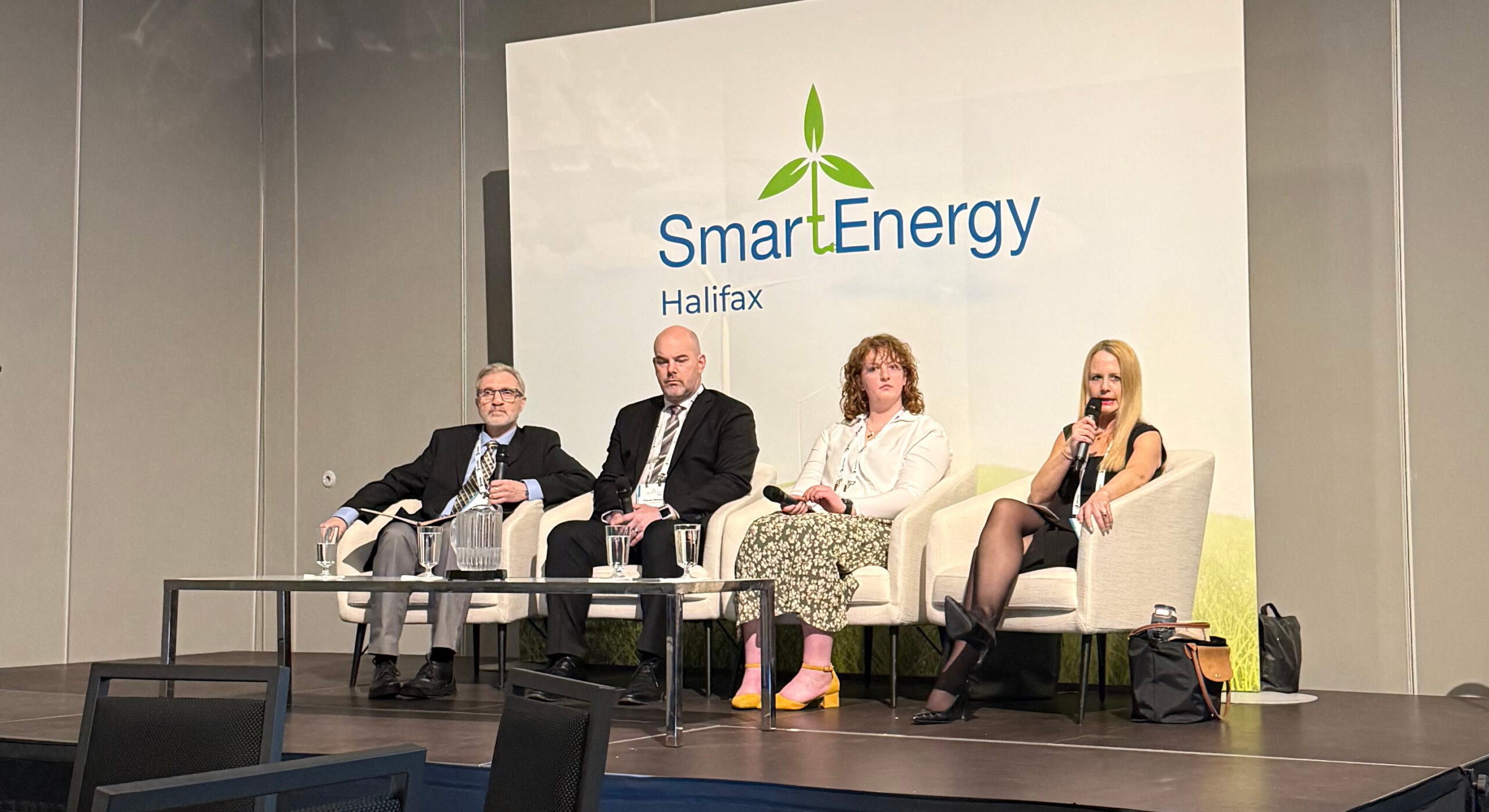
In April I had the chance to speak on panels at both the Hydrogen East and SmartEnergy conferences in Halifax. Then it was Edmonton later in the month for the Canadian Hydrogen Convention. In May I was in Rotterdam for the World Hydrogen Summit, and last week I spoke on a panel at the Canada-UK Business Summit in London.

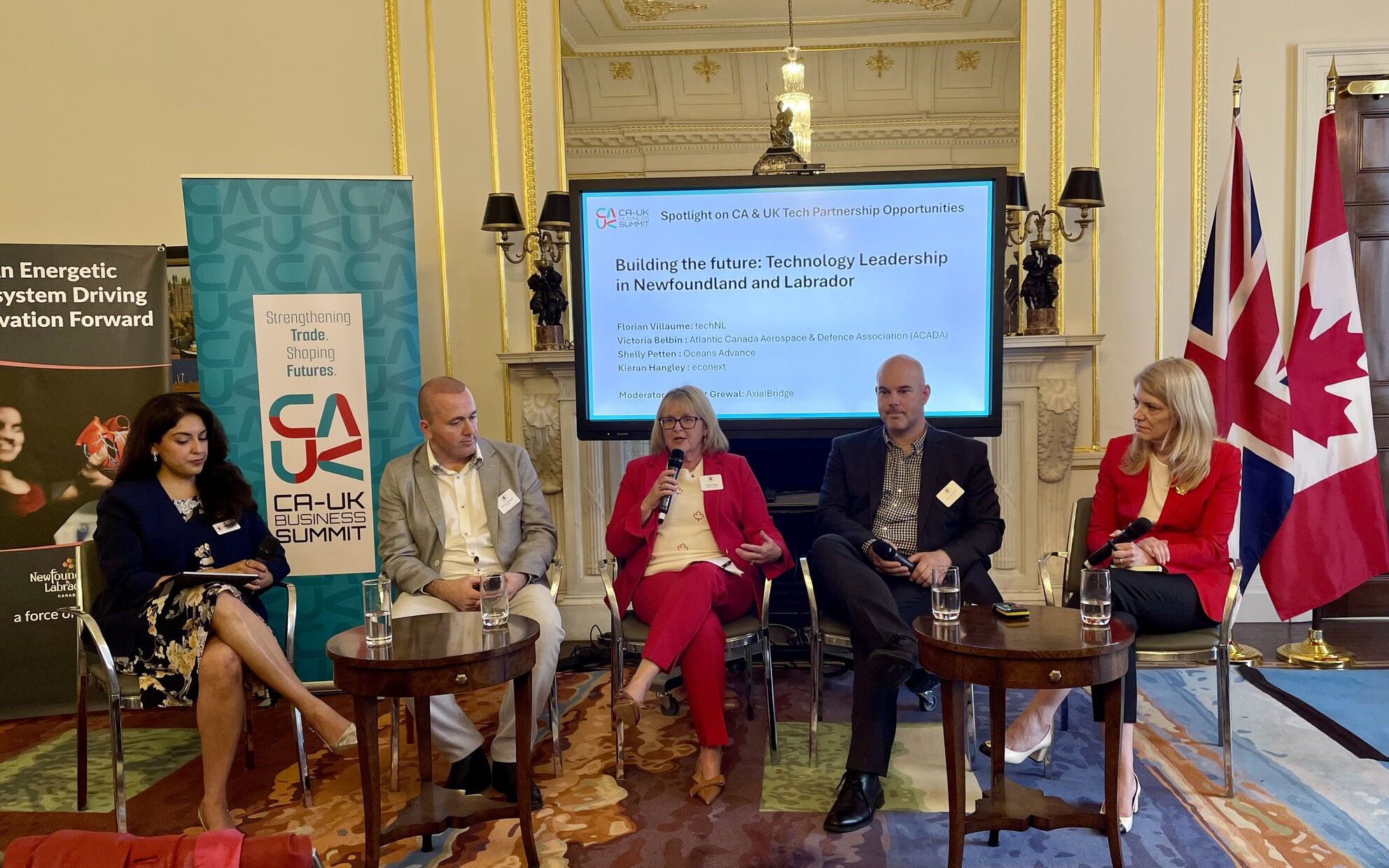
At the Canada-UK Business Summit sharing the stage with Moderator Jaspreet Grewal, Florian Villaumé (Tech NL), Shelly Petten (Oceans Advance), and Victoria Belbin (Atlantic Canada Aerospace and Defence Association).

From Western Canada to continental Europe, our province is becoming recognized for its major clean energy developments – namely the six wind-to-hydrogen projects being pursued and the NL-Quebec MOU to develop/augment the Upper Churchill hydro resources. Whether it’s wind or water (or a combination of both), these projects are at scales which put Newfoundland and Labrador at the forefront of the global energy transition. Plus: critical minerals!

Through these past couple of months, there were a couple of things I have taken away that I think are worth sharing.

Newfoundland and Labrador’s export-oriented clean energy industry is not the norm in Canada

First, within the Canadian context, our province is fairly unique in that much of the clean energy development being pursued is for export. The Canadian conversation at large is focused on the adoption of clean energy and clean fuels, whereas the opportunity in Newfoundland and Labrador is predominantly production for trade purposes*.

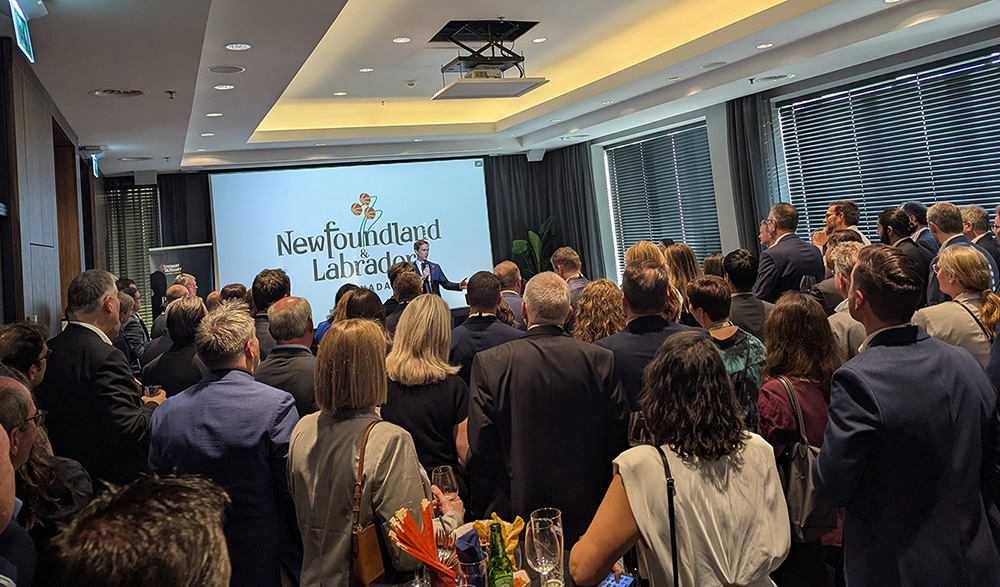
Premier John Hogan at the World Hydrogen Summit in Rotterdam. An impressive showing given he was sworn in only ~10 days prior!

Given that the nature of the projects we are seeing in NL are different from elsewhere in Canada, we have to be deliberate and determined in advocating for this industry nationally – because nobody else can or will. A good analogy for this would be our oil and gas industry. Sure, there’s oil and gas production elsewhere in Canada… but nobody else does it offshore. Our clean energy industry is evolving differently as well, and will need bespoke supports to make it thrive. We need to be loud about this.

Uncertainty in Newfoundland and Labrador is outweighed by unshakeable confidence in Europe

The advancement of wind-to-hydrogen projects in our province have not taken place at the speed which many were predicting some years ago. This has bred some uncertainty within the province about the whole enterprise.

But when in Europe, the adoption of hydrogen technologies is a foregone conclusion. It is not a debate. In fact, some jurisdictions are doubling down on previous commitments. Europe wants green hydrogen and – learning lessons from relying too much on one source (Russia) for energy in the past – wants a diverse array of suppliers. They are counting on Canada to be one of those suppliers, and that means Newfoundland and Labrador.

Mark Hunter (GovNL), myself, Jenna Broders (North Atlantic), and Susan Wilkins. Let’s hope econext‘s next CEO takes a better picture than I do.

There is infrastructure that needs to be built and pricing challenges that need to be addressed. With time and hard work, these hurdles will be overcome.

When you’re in the middle of something that is brand new, progress feels like it takes an eternity. In retrospect, much has been achieved in just a few short years. Yes, a lot of work still needs to be done. But the fundamentals remain: Europe wants clean energy and Newfoundland and Labrador not only has lots of it but has a whole host of other competitive advantages to boot.

Let’s face it: if a Newfoundlander was told in 1975 that one day soon the province would be producing oil over 300km offshore – and then shipping it halfway around the world – I suspect they would have some doubts.

An important year ahead

In the next year we are expecting to see developers advance through environmental assessment and permitting processes. We are expecting to see the NL-Quebec MOU take shape into an agreement. We are expecting concrete (and much needed) advancement for our domestic electricity grid.

Unexpected things will happen. There will be ups and downs along the way, but the underlying conditions continue to position our province favourably.

I suppose the big lesson for me through these recent travels is that the more I am exposed to the exciting things happening throughout Canada and around the world – the more I realize that what is taking place in Newfoundland and Labrador is very special. We are on the cusp of big things here in this province, and it’s important we keep our eye on the ball.

Don’t be shy about Newfoundland and Labrador’s clean energy future. We need the nation and the world to know!

// Kieran

* A couple of caveats with this comment so I don’t get myself in too much trouble. Just to be clear, the economic driver is export. But clean fuels use domestically is still very important for the decarbonization of our economy and Newfoundland and Labrador’s achievement of net zero by 2050. And from an electricity perspective, I definitely don’t want to suggest that we don’t need a lot more electricity for domestic use.

IATSE Local 709

IATSE Local 709 is a not-for-profit labour organization representing workers on crews in the film and television production industry in Newfoundland and Labrador.

Wildfires in Newfoundland and Labrador: From readiness comes resilience 

June 18, 2025 – econext’s thoughts are with those impacted by wildfires in Central NL and Labrador. Please see the resources below for local information and support.

From Readiness Comes Resilience 

It used to be that when we thought of wildfires, our minds likely shifted to places like Australia, California, or Western Canada. But the idea of wildfires in Newfoundland and Labrador? Historically, it hasn’t been top of mind.

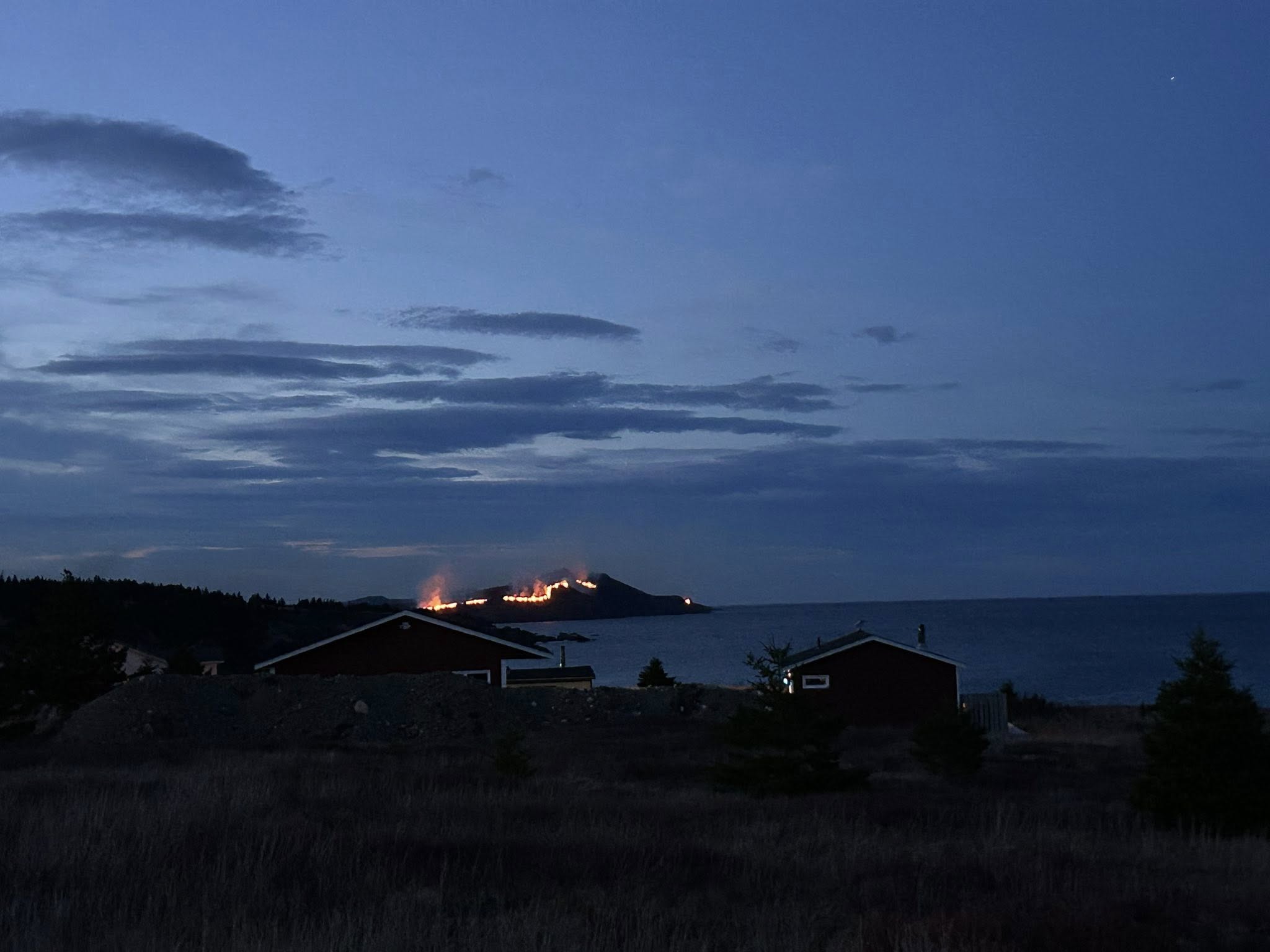
All of that changed in the summer of 2022, when a series of major fires erupted in central Newfoundland, sparked by lightning strikes during a spell of intensely hot and dry weather. These blazes were some of the largest forest fires to ravage the island in its history, ultimately consuming over 228 square kilometers of land.

The fires caused widespread disruption and hardship. Roads and highways, some of which were the only means of connecting and supplying towns, were closed for days. Grocery store shelves were quickly emptied, and in some cases, food and supplies had to be flown in by helicopter. The smoke and poor air quality also prompted officials to declare a state of emergency in the city of Grand Falls-Windsor and several surrounding communities.

The searing images captured of forests, that were now nothing but ash and charred tree trunks, looked like something out of a post-apocalyptic movie- a far cry from the picturesque landscapes Newfoundland and Labrador is known for.

In the years since, wildfires have continued to threaten communities across the province. In July 2024, Labrador was hit by its largest-ever wildfire evacuation as fast-moving fires swept through communities including Labrador City, Wabush, and Churchill Falls, forcing thousands from their homes and severely disrupting daily life. The fires posed a direct threat to critical infrastructure, most notably the Churchill Falls hydroelectric generating station, which supplies electricity to both Labrador and Quebec.

As the wildfire near Churchill Falls crossed the Churchill River, it forced the evacuation of the plant and led to the shutdown of two major transmission lines, resulting in widespread power outages for residents and major iron-ore mines in Labrador West. Emergency power was supplied from Fermont, Quebec, but rotating outages and industrial disruptions persisted, highlighting the region’s vulnerability and the lasting impact on local families, businesses, and essential services.  Then, in 2025, new wildfires broke out in both Adam’s Cove and Labrador, prompting fresh warnings and renewed calls for vigilance as dry conditions and high fire risk persisted.


Why the future looks…smoky

It’s important to note that wildfires are a natural occurrence that play an important role in many ecosystems. They clear dead organic matter from the forest floor and help with nutrient cycling and plant regeneration. However, with global warming and increasing temperatures, the risk of wildfires has increased. Drier conditions and longer fire seasons are the new normal, and it’s not just Newfoundland and Labrador that’s feeling the heat.From the Amazon rainforest to the Australian outback, wildfires are ravaging ecosystems and communities at an alarming rate. Climate change is exacerbating these three major factors that influence wildfires, which when combined pose a significant threat to communities and ecosystems:

1. Dry fuel to burn: As temperatures rise, vegetation dries out more quickly, creating more fuel for fires to start and spread.

2. Frequent lightning strikes: Climate change also promotes the development of more storms capable of producing lightning, which is the chief cause of forest fires. These lightning strikes often ignite fires in remote areas, making them harder to detect and respond to.

3. Dry, windy weather: Hot and dry weather, or “fire weather,” is becoming more frequent, making fires harder to put out and intensifying the fire season. Topography also has a major impact on the spread and behavior of wildfires. When fires burn uphill, the flames are closer to the fuel, causing them to spread faster due to the increased fuel availability and drier conditions. Meanwhile, terrain like valleys and ridges can act as barriers to control the spread of the fire.

A heated relationship

The relationship between climate change and forest fires is a complex one. While forest fires can contribute to global warming through the release of greenhouse gas pollution, a warming planet also increases the likelihood of fires. It’s a cycle that can have negative consequences for the environment and for communities, but there are actions we can take to reduce its impact.

A fiery dance we can learn from

Think of a fire regime like a dance with partners: climate, ignitions, and vegetation. These partners come together to create a unique rhythm of fire events across a broad landscape and over a long span of time.

Climate sets the tempo, with warm, dry summers providing a beat for frequent fires. In Newfoundland and Labrador’s boreal forest, for example, a lack of rainfall and scorching summer temperatures provide the perfect conditions for these fiery events to take place. By observing these connections, we gain a deeper understanding of the patterns that shape the region and the relationships between these partners.

Beating the heat at home

By taking steps to maintain and protect the area surrounding your home, you can reduce the risk of wildfire damage. This can include removing dead vegetation and keeping trees trimmed, using fire-resistant materials in landscaping and construction, creating defensible space, and having an evacuation plan in place.

FireSmart leads the development of resources and programs to help Canadians increase resilience to wildfires. Learn more here and be sure to download their app to your phone:

https://firesmartcanada.ca/

If you want to dig deeper or stay informed, here are some great resources to check out:

– The Government of Newfoundland and Labrador offers a detailed Wildfire Preparedness and Prevention Guide. It covers fire bans, safety tips, and current fire updates. This is a great resource to understand local wildfire risks and rules.

Wildfire Prevention – Fisheries, Forestry and Agriculture

– To track wildfires in real time, explore Newfoundland and Labrador’s interactive Wildfire Dashboard. It shows current fire locations, sizes, and status. This tool is especially useful during fire season.

NL Active Wildfire Mapping Application

-The Canadian Red Cross provides useful information to help you prepare for and recover from wildfires in your community.

Wildfire Information and Support – Canadian Red Cross

Using these resources can help you stay prepared and protect your home and community from wildfire threats.

The burning question

With wildfires, it’s not just the natural environment that is at risk. These fires also threaten the communities that call Newfoundland and Labrador  home. The toll on property, infrastructure and loss of life can be significant and heartbreaking.

As wildfires become more prevalent in Newfoundland and Labrador, we face a pressing question: how do we adapt to this new reality? The most obvious answer is clear and well-known by now: we need to take immediate action to curb greenhouse gas emissions and slow the warming of the planet. But we also need to prepare ourselves for the inevitable impacts of climate change that are already happening.

This means a focus on fire prevention and management as well as disaster preparedness and response. All stakeholders have a role to play in this – whether its governments, communities, businesses, or individuals.

The increasing threat of wildfires in Newfoundland and Labrador is a stark reminder that climate change is not a distant threat. If you are interested to learn about how climate change presents risk for your community or business – and what you can do to prepare – contact Sepehr Khosravi, our province’s climate services specialist from CLIMAtlantic.

econext insights: Opportunities for Domestic Clean Fuels Use in Newfoundland and Labrador

As jurisdictions around the world work to reduce greenhouse gas emissions and build more resilient energy systems, clean fuels are emerging as a key part of the solution. With abundant natural resources and a growing focus on innovation, Newfoundland and Labrador is well-positioned to lead in this transition. Join econext for an online workshop as we explore the opportunities and challenges of clean fuel adoption across some of the province’s most critical economic sectors.

This session builds on the findings of econext’s recent research, which took a sector-specific approach to assessing the potential for clean fuel use within Newfoundland and Labrador. The research focused on the following areas:
• Marine Transportation
• Port Operations
• Electricity Grid Integration
• Remote Communities
• Heavy Industry (e.g. Mining)
• Heavy Duty Transportation
• Public Transportation
• Aviation

Session participants will be provided with a high-level overview of the study’s findings and invited to offer feedback that helps validate and enhance the insights. Your input will help shape future work, ensuring it reflects real-world needs and supports informed decision-making.

If you’re a stakeholder in any of these areas—whether you work in operations, infrastructure, energy, or policy—your perspective is vital. This is a chance to connect with peers, share your expertise, and contribute to shaping a cleaner, more sustainable energy future for Newfoundland and Labrador. Register now to take part in this important conversation.

Register now

This event is made possible through the support of Natural Resources Canada / Ressources naturelles Canada.

econext Summer Social 2025

Celebrate the Summer with econext!

Join us for the econext Summer Social on Thursday, July 17th, 2025 from 3:00pm – 5:00pm, in partnership with takeCHARGE! This in-person event will take place at Wooden Walls Distilling, 140 Harbour Drive, St. John’s.

Connect with fellow professionals in the industry and enjoy a fun-filled afternoon of networking, refreshments and snacks. This is a great opportunity to expand your professional network and connect with the econext team. Be sure to get your tickets by 4:00pm on Friday July 11th.

Space is limited – don’t miss out on this exciting event! Register now and secure your spot. See you there!

Buy Tickets Now

econext publishes discussion paper exploring biomass energy opportunity in Newfoundland and Labrador

For Immediate Release
June 11, 2025

econext has published a discussion paper exploring opportunities in Newfoundland and Labrador for biomass energy.

“Organic waste makes up over 30% of the material that ends up in our landfills,” said Kieran Hanley, econext‘s CEO, noting that there is also significant organic waste that does not make it to landfills. Hanley said that when organic waste breaks down it creates very harmful greenhouse gas emissions. “This amounts to at least 7% of our province’s total emissions – but there is value in this waste that is otherwise just decomposing.”

“Technologies to turn this waste into forms of low-carbon energy are quickly advancing,” said Hanley. “We have come to believe that there is an opportunity for our province to address its biggest waste management challenge – while simultaneously decarbonizing other parts of our economy – through biomass energy.”

Download Discussion Paper

The intent of the discussion paper, said Hanley, is to add new life to that discussion in Newfoundland and Labrador. “In this paper we have done our best to identify organic waste streams, explore relevant technologies and energy outputs, define domestic end uses, and present information that may inform future innovative business models; we hope this inspires others to take a serious look at the opportunity.”

The discussion paper complements a recently-published discussion paper which defines end uses for clean fuels in the province.

Hanley said the paper is intended to be evergreen and that the organization will look to econext‘s members and partners help to improve upon it. “If you can help us improve our assumptions and rationale, please get in touch – this is just our first step.”

About econext

econext is a not-for-profit association with a mission to accelerate clean growth in Newfoundland and Labrador by: (1) stimulating research, development, and innovation; (2) preparing its workforce for a greening economy; and (3) acting as a catalyst for climate change action within its industries, businesses, and communities. econext has been working for over 30 years on behalf of its members across many sectors to support environmentally sustainable economic development. For more information, visit https://econext.ca/.
Discussion Paper: The Potential for Biomass Energy in Newfoundland and Labrador

The objective of this paper is to generate discussion and encourage further exploration of biomass energy and organic waste management in Newfoundland and Labrador (NL).

Data regarding waste streams in NL (particularly industrial waste streams) is incomplete, while biomass technologies and their applications are quickly advancing. It is fully expected that stakeholders in NL have access to information and/or insights that could improve the quality this discussion paper; this document is intended to be evergreen and will be updated when new information comes to light.

econext welcomes all feedback that can help improve the quality and usefulness of this discussion paper. Feedback can be sent to info@econext.ca. The linked document is current as of June 11, 2025.

Download Discussion Paper

econext seeking businesses looking to better understand their environmental impacts

Are you a business looking to better understand your environmental impacts?

Throughout 2025-2026, econext will be working with 25 businesses across the province to quantify environmental impacts by helping them to undertake greenhouse gas (GHG) assessments, energy efficiency analysis, and waste audits. econext will engage experts to work on each of these assessments.

Following the acquisition of this information, econext will provide tailored advice for each business on the steps that they can take to “green” their operations in a way which helps improve competitiveness and productivity. Having this information in hand will help small-to-medium businesses (SMEs) make decisions about future “green” investments; help with establishing Environmental, Social, and Governance (ESG) commitments; and serve to be powerful tools in marketing.

Contribution

Thanks to funding from the Department of Industry, Energy and Technology and the Atlantic Canada Opportunities Agency, econext is pleased to cover 75% of the costs. It is estimated that the total cost of providing these services is $10,000 on average, depending on the scope and size of the business.

Selection Criteria

To be eligible for participation, businesses must meet the following criteria:

  • Have operations in the province of Newfoundland and Labrador
  • Be one of the following: involved in a supply chain, exporting internationally, or expecting to try to attract private investment
  • Have the capacity to help acquire data necessary for the assessments
  • Cannot be involved in retail or provision of personal services

It is also important that participating businesses have ownership of their buildings for this project, as this will allow them to make changes based on the findings to improve environmental impact (ie. increasing energy efficiency and decreasing GHG emissions).

If your business sounds like a good fit, or if you have questions and would like to learn more, reach out to Business Sustainability Lead, Alex Rumbolt at alex@econext.ca.

About econext

econext is a not-for-profit association with a mission to accelerate clean growth in Newfoundland and Labrador by: (1) stimulating research, development, and innovation; (2) preparing its workforce for a greening economy; and (3) acting as a catalyst for climate change action within its industries, businesses, and communities. econext has been working for over 30 years on behalf of its members across many sectors to support environmentally sustainable economic development. For more information, visit https://econext.ca/.
econext welcomes provincial government investment into workforce development for the green economy


For Immediate Release
June 9, 2025

econext is pleased to welcome today’s announcement by the Honourable Gerry Byrne, Minister of Jobs, Immigration and Growth, of a $1.99 million investment in the organization’s Accelerating Clean Growth: Green Economy Workforce Development Project.

This support from the Government of Newfoundland and Labrador allows econext to continue building the capacity of the province’s workforce to meet the needs of a growing green economy – including its clean energy sector.

“Newfoundland and Labrador’s green economy is primed for rapid and substantive growth,” said Kieran Hanley, econext’s CEO. “From our emerging wind-to-hydrogen industry to the expansion of our electricity grid, making sure we have the workers in place with the right skills will be a key success factor.”

Launched in 2023, the project is in collaboration with academic, industry, and workforce stakeholders. It is helping to prepare Newfoundlanders and Labradorians for opportunities in renewable energy industries such as wind, hydrogen, hydroelectricity, and the bioeconomy.

“By helping to build the skills and capacity needed for clean development, this project directly supports econext’s broader mission of positioning Newfoundland and Labrador as a world leader in the green economy.”

About econext

econext is a not-for-profit association with a mission to accelerate clean growth in Newfoundland and Labrador by: (1) stimulating research, development, and innovation; (2) preparing its workforce for a greening economy; and (3) acting as a catalyst for climate change action within its industries, businesses, and communities.

econext has been working for over 30 years on behalf of its members across many sectors to support environmentally sustainable economic development. More information can be found at https://econext.ca.