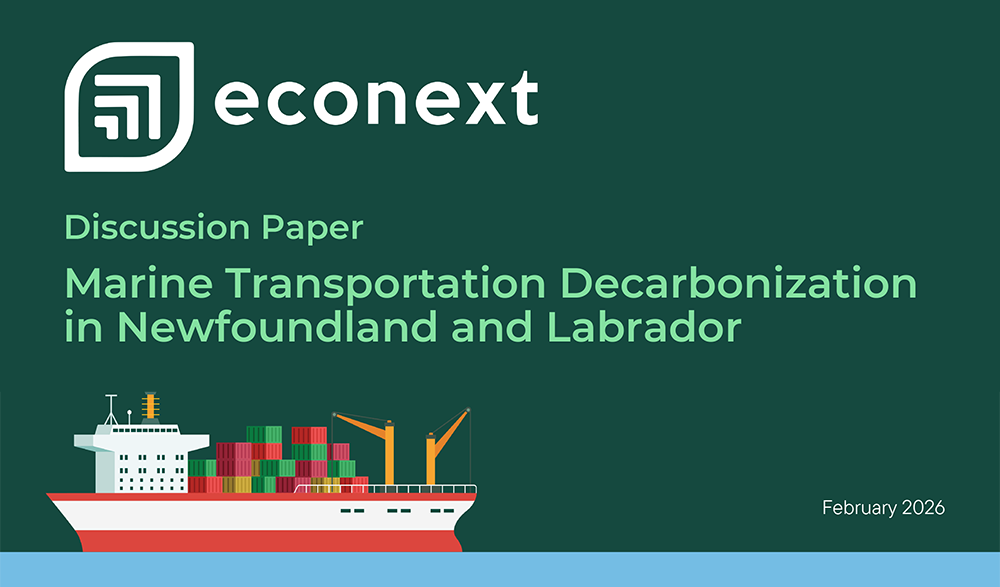
Discussion Paper: Marine Transportation Decarbonization in Newfoundland and Labrador

Marine transportation accounts for 8% of greenhouse gas (GHG) emissions in Newfoundland and Labrador (NL). The sector is not well understood in NL from a GHG perspective while, at the same time, research has shown that the marine transportation sector has the greatest potential for low-carbon fuel adoption within the province. These factors led to econext prioritizing the advancement of marine transportation decarbonization planning and activities within the province.

There are environmental and economic benefits to be achieved in NL through the decarbonization of marine transportation. This discussion paper contains new analysis of data that has only recently become available; econext hopes that this effort helps advance net zero planning and activities in NL’s marine transportation sector.

Download the Report

Download One-Pager

Discussion Paper: Sustainable Film and Television Production in Newfoundland and Labrador

A new report led by econext, in partnership with PictureNL and local stakeholders in the film and television community, is laying the groundwork for a more sustainable future for the industry in Newfoundland and Labrador. The environmental scan, the first of its kind in the region, establishes a baseline understanding of the sector’s environmental performance and identifies opportunities for cleaner, more efficient film production practices.

The study was informed by a series of workshops, set visits, and individual consultations with producers, crew members, suppliers, and service providers. Through these conversations, econext developed a report that captures how the local industry operates and where practical improvements can make the most impact.

The report outlines several recommendations designed to help productions and suppliers take incremental, but meaningful, steps toward sustainability. Among the recommendations are the following:

  • Phasing out single-use items in catering and craft services, and diverting organic waste
  • Identifying rental vehicle supplier options to include hybrid and zero-emission vehicles
  • Collaborating with property owners to improve energy efficiency at production sites
  • Exploring partnerships for zero-emissions and low-carbon power generation for production base camps and on-location filming

These actions will help film productions meet the environmental requirements of major funders and distributors and also enhance the province’s ability to attract large-scale projects from international studios such as Netflix, Apple and Disney.

Click to Download the Report

Discussion Paper: Energy Storage Applications and Potential in Newfoundland and Labrador

Energy storage is viewed internationally as being key in the fight against climate change, as it allows for the stabilization of renewable energy supplies which are oftentimes intermittently available – when the sun does not shine and the wind does not blow.

The objective of this discussion paper is to outline a range of technologies and consider their various possible benefits within the context of Newfoundland and Labrador – including barriers that may exist to their adoption.

Download Discussion Paper

Discussion Paper: The Potential for Biomass Energy in Newfoundland and Labrador

The objective of this paper is to generate discussion and encourage further exploration of biomass energy and organic waste management in Newfoundland and Labrador (NL).

Data regarding waste streams in NL (particularly industrial waste streams) is incomplete, while biomass technologies and their applications are quickly advancing. It is fully expected that stakeholders in NL have access to information and/or insights that could improve the quality this discussion paper; this document is intended to be evergreen and will be updated when new information comes to light.

econext welcomes all feedback that can help improve the quality and usefulness of this discussion paper. Feedback can be sent to info@econext.ca. The linked document is current as of June 11, 2025.

Download Discussion Paper

Discussion Paper: Opportunities for Digital, Remote, and Autonomous Operations in Clean Energy

The objective of this discussion paper is to advance a conversation locally on the potential for innovation in subject areas that are strengths for Newfoundland and Labrador – digital, remote, and autonomous operations – within the context of the province’s emerging clean energy industry.

Download the Report

Discussion Paper: Economic Development and Climate Change Adaptation in Newfoundland and Labrador

The economy of Newfoundland and Labrador (NL) and the lifestyle of its residents have always been deeply connected to the land and ocean, and the natural resources that abound from them. From agriculture and fisheries, mining and energy generation, to tourism, the arts, and the activities of everyday life, we have built systems and narratives that rely on a stable climate and healthy ecosystems to function optimally.

The reality is that we have entered a period of climate instability and what has worked for us in the past is now experiencing vulnerability and strain. Climate change is actively shifting our baseline and we must reframe our decision-making accordingly. We must consider more factors, ask ourselves new questions, and look further ahead than we may have before. Incomplete analysis and short-sightedness at this point in history may not only lead to poor investment outcomes, but even risk to life.

As decision makers invest into economic development initiatives in the province, it is therefore important to consider how the changing climate will impact proposed plans. This discussion paper aims to illustrate the connections between climate change and economic development in NL so that we can move forward in a way that minimizes risk and maximizes benefits for all.

Download the Discussion Paper

Discussion Paper: Clean Fuels and Economic Development in Newfoundland and Labrador

econext has released a discussion paper which explores the economic development opportunities for Newfoundland and Labrador that are associated with the emerging clean fuels industry.

“We believe that clean fuels production presents an enormous opportunity for Newfoundland and Labrador, its economy, and its communities,” said Kieran Hanley, econext‘s CEO – referring to the wind energy to hydrogen projects being proposed within the province.

Hanley said it is important to view the potential benefits of the emerging industry beyond just those that come with construction and operations and the export of a commodity. “Newfoundland and Labrador has the potential to be among the first in the world to produce clean fuels at this scale, and with that comes a series of time-sensitive opportunities to position ourselves as leaders in innovation and training and attract more green industry.”

Download the Discussion Paper

“The purpose of this discussion paper is twofold,” said Hanley. “First, we want to create a greater awareness of the opportunities that are before the province, and second we want to get decison-makers and stakeholders thinking about how we go about pursuing those opportunities.” Hanley said that the discussion paper is intended to be the start of the conversation, and is not a definitive or conclusive report. “We welcome any and all feedback that can help us better understand these opportunities.”

“I would like to thank all of the econext members who provided their time and many of the ideas that are represented in the paper,” said Hanley. “econext looks forward to doing its best to advance many of the opportunities identified on your behalf.”

econext is an association of businesses that accelerates clean growth in Newfoundland and Labrador and works on behalf of over 200 members to foster environmentally sustainable economic development. More information can be found at https://econext.ca.

— 30 —

Media Contact:
Kieran Hanley
kieran@econext.ca

Discussion Paper: Addressing Future EV Battery Waste in Newfoundland & Labrador

It is well established that electric vehicles will reduce GHG emissions, however there have been recent concerns about the downstream environmental impacts – particularly with the disposal of batteries. Taking a circular economy approach to the waste management of batteries makes sense but, in general, economics for established methods of waste management are difficult to adopt in Newfoundland and Labrador due to economies of scale and geography. This discussion paper explores the challenges and the possibilities.

Download Discussion Paper

Discussion Paper: The Hydrogen Economy and the Potential for Newfoundland and Labrador

The intent of the discussion paper is to create a broader awareness within the province on what the possibilities may be for the production and/or consumption of hydrogen – and what further explorations are required to narrow in on and define the real opportunities.

Download PDF